

When they approach the Sun, we can see comets from the Earth with the naked eye. While they are Small Solar System Bodies (SSSBs), ranging from hundreds of metres to kilometres in size, we can nevertheless observe their millions-of-kilometres-long tails. Comets are similar to asteroids, with the main difference being that comets get close enough to the Sun for solar heat and wind to affect their behaviour. By heating up cometary water and other ices and ionising the released material, some of the comet’s mass is left behind in two distinctive tails. While the dust tail has a direction opposite to the orbital trajectory, the plasma tail of charged particles streaks out in the opposite direction from the Sun.Where do comets come from?
In the early 1930s, an Estonian astronomer, Ernst Öpik, was puzzled by the fact that we can still observe active comets despite the fact that the age of the Solar System is more than 4.5 billion years. Given the mass-loss rate of comets, they should have vanished within millions of years of their formation. Öpik postulated a theory that comets originate from a cloud far beyond the orbit of Pluto. Nowadays, we call this the Öpik–Oort cloud, and we know that it extends up to thousands of astronomical units (au). In the 1950s, a Dutch astronomer, Jan Oort, also suggested that the Solar System is surrounded by long-period comets, far beyond the orbits of Neptune and Pluto.
Due to gravitational perturbations by other stars of the Milky Way galaxy, Öpik–Oort cloud objects sometimes divert from their ancient courses and race towards the Sun. This rare astronomical occurrence provides an opportunity to observe an object that has remained frozen since the formation of the Solar System. Compared with short-period comets (those with an orbital period of less than 200 years), dynamically new ones are believed to have a pristine surface material with very little volatile loss and weathering by the solar wind. Studying such an object should provide valuable insights into the conditions of the early Solar System, but to do so will require a new kind of mission. [4]
How to intercept a pristine Öpik–Oort cloud comet?
The most unique aspect of the Comet Interceptor mission is the fact that it must be designed without knowing its target or the precise geometry of the flyby encounter. The project is possible because large sky surveys are now finding incoming comets with greater warning times, of a few years at least, and the Vera C. Rubin Observatory is expected to greatly increase our ability to discover comets years before they reach perihelion, the point in orbit at which the incoming comet is closest to the Sun. It would likely take about five years between discovery of a yet-unknown, dynamically new comet and interception. The target comet may be found during the development and qualification phases, before the mission is launched, but it is still unknown as the mission and spacecraft design is being fixed. [5, 6]
This means that the Comet Interceptor mission must be designed to be as flexible as possible, and must be able to cope with a wide range of targets and encounter geometries.
Given these constraints, the Comet Interceptor spacecraft will be launched to the Sun–Earth L2 Lagrangian point, where it will lie in wait for up to six years in order to give enough time for comet discovery and a bit of a margin for orbital manoeuvring towards the new visitor to the inner Solar System. Comet Interceptor is currently planned to be launched in 2029 with the ARIEL space telescope, similarly to how Gaia does.
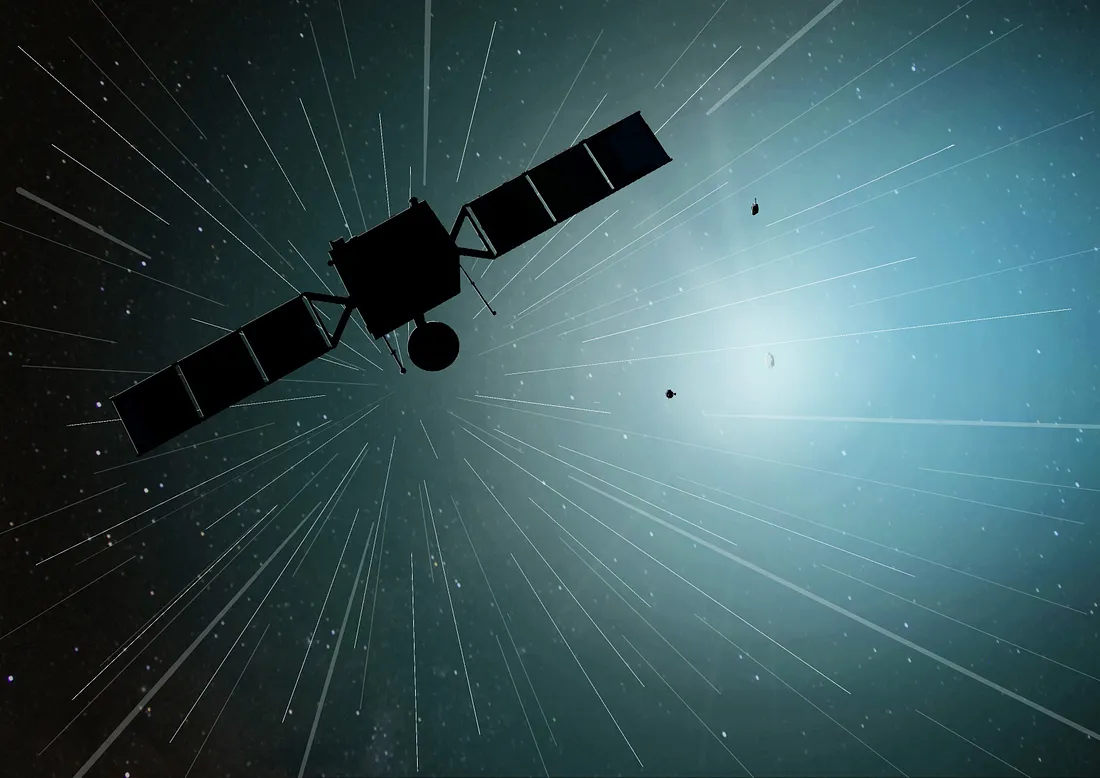
The ESA mission comprises the main spacecraft – Spacecraft A – and two smaller Probes – B1 and B2, with the first probe being developed by the Japanese Space Agency (JAXA). The main spacecraft will fly past the comet at a distance of about a thousand kilometres to avoid any damage from material nearby, while the smaller probes will dive closer, down to as little as 400 kilometres from the surface. [6]ESA ‘adopted’ the Comet Interceptor mission in June 2022, which means the study phase is complete, and, following selection of the spacecraft prime contractor, work will soon begin to build the mission. While OHB Italia signed the contract with ESA in December 2022 to move forward with the design and construction of the ambitious Comet Interceptor spacecraft [7], the instrument teams have been designing the unique Comet Interceptor instrument suite since June 2019 when the mission was selected as the first of the ESA Fast-class missions. As a matter of fact, the instrument teams have already passed three ESA instrument design review cycles and carried out a range of projects that have established the instrument development activities.