

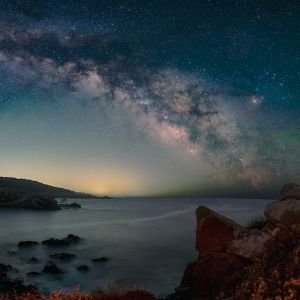
Galaxies are made up of stars, planets, and great clouds of dust and gas, all held together by gravity. However, not every galaxy looks the same. While most galaxies are spiral or ball-shaped, some are less structured and have irregular forms. Small galaxies have several thousand stars and reach a few hundred light-years across. On the other hand, large galaxies contain trillions of stars and stretch millions of light-years. Oftentimes large galaxies have supermassive blackholes at their centers – like our own.
Our solar system, located in a small arm of the Milky Way, orbits the center of the galaxy at over 500,000 miles per hour. At the center of the Milky Way lies a supermassive blackhole surrounded by an incredible number of stars. The closer to the center of the galaxy you get, the older the stars become. As far as we know, our solar system is the only one that possesses life. However, with powerful new instruments like the Roman Space Telescope, we will have the ability to look at planets beyond those in our solar system.


Photo credit: NASA – Nancy Grace Roman Space Telescope Illustrations
The Nancy Grace Roman Space Telescope
With a view expected to be over 100 times greater than the Hubble Space Telescope, the Roman Space Telescope will provide the deepest view of the center of our galaxy than ever before. The Roman Space Telescope will give scientists unprecedented insight into dark energy, exoplanets, and infrared astrophysics.
Planned to launch no later than May 2027, the Roman Telescope will conduct several surveys that will revolutionize astronomy and answer long existing questions about dark matter, dark energy, and exoplanets. The final survey conducted by the telescope will study the stars and exoplanets in the area around the center of the Milky Way, known as the galactic bulge. The galactic bulge region is relatively unknown to scientists, but with a method called microlensing through the Roman Space Telescope, we can study exoplanets and planetary systems farther from Earth than ever before.
The Big Picture
It is still not known how common planets like Earth are, but the surveys conducted by the Roman Space Telescope will provide greater context for Earth and our solar system. The results from the surveys will help scientists distinguish commonalities in the exoplanets they discover and therefore advance their knowledge of planetary formation and habitability. It is a very exciting time in astronomy!
A Galaxy Near You
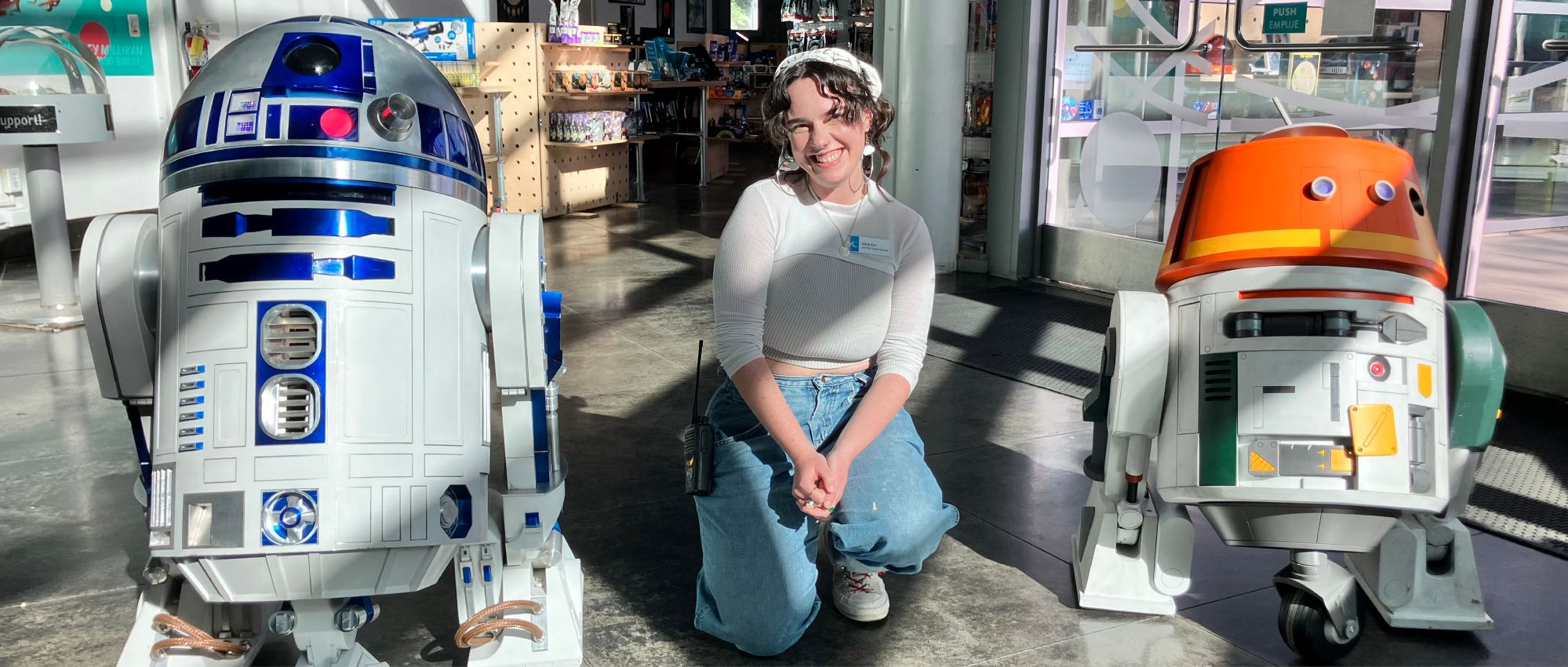
If you would like to explore a galaxy outside our own, Chabot Space & Science Center will be hosting a spectacular sci-fi night called A Galaxy Not So Far Away on Friday, May 1st. Guests will have the opportunity to craft their own glowing swords, get a glimpse of distant planets through our historic 8” refractor telescope known as “Leah,” and discover the mechanics of robotics alongside a familiar sassy android. Then, don’t forget to snap a pic in our Galaxy Photobooth, enjoy a themed cocktail, and discover the facts behind the fiction in your favorite intergalactic fantasy movies. Perfect for fans of all ages, this is a sci-fi inspired adventure you won’t want to miss!
In more great news, Sci-Fi movie nights are back at Chabot! On Monday, May 4th, bring a friend and join us for a one-night-only screening of Star Wars: A New Hope in our Theater – our Planetarium showing has sold out. Come early to enjoy light bites and themed cocktails in this fun, after-hours date night at the museum. Plus, check out our NASA Ames Visitor Center and AstroLight exhibit, open late for this event!